
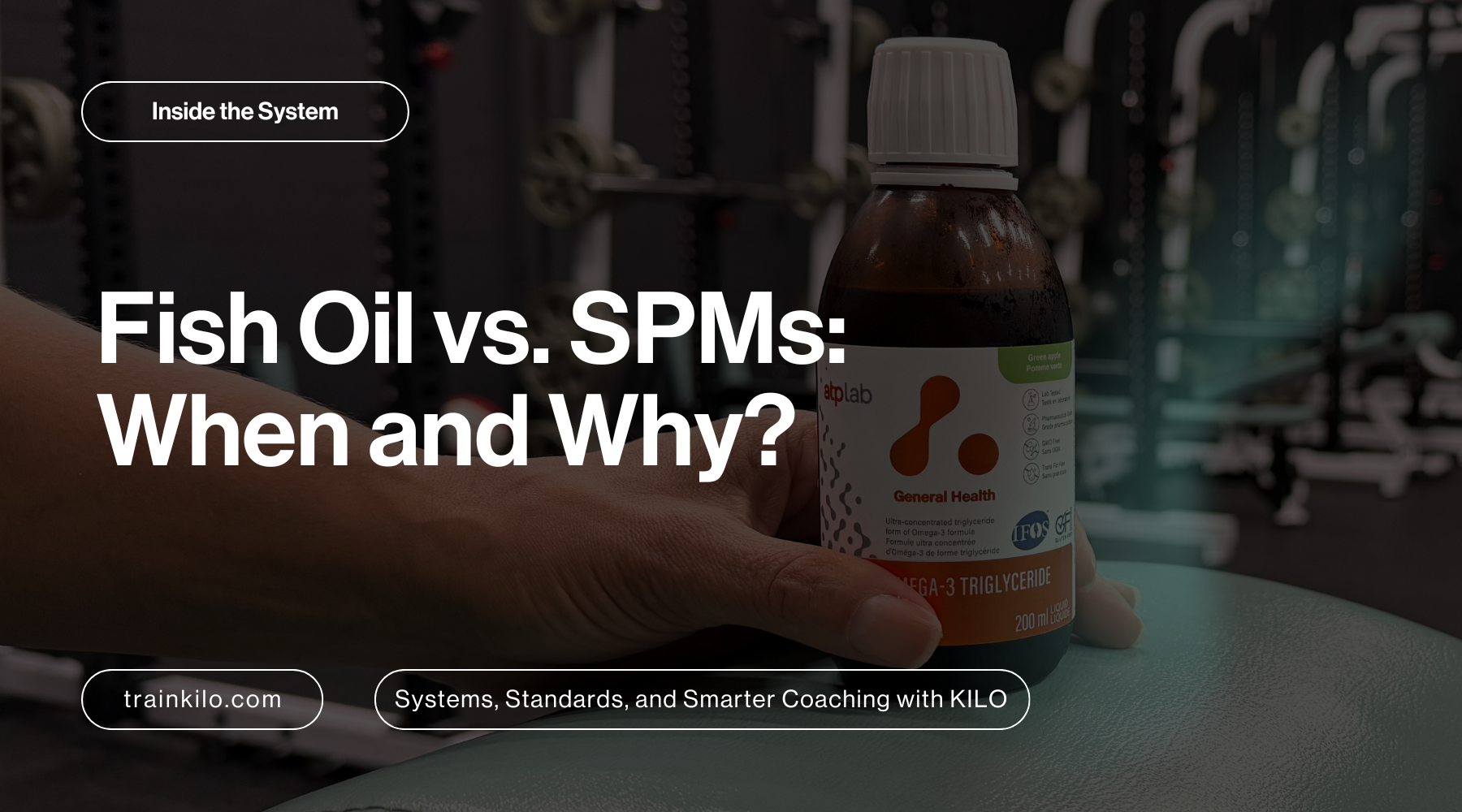
Inflammation is not the enemy. It’s part of the process. But when resolution stalls and inflammation lingers, recovery suffers; and decreased performance follows.
Most lifters and coaches know omega-3s help with recovery. But few understand that what kind of omega-3 you use, and when, matters. Fish oil and SPMs (Specialized Pro-Resolving Mediators) are not interchangeable. They work differently in the body, and each plays a distinct role in the inflammatory cascade.
This article outlines the key differences, the emerging research, and how we recommend using both in the KILO system, especially when inflammation threatens adaptation.
Fish Oil vs. SPMs: What's the Difference?
At a glance:
-
Fish oil provides upstream raw materials: EPA and DHA, long-chain omega-3 fatty acids used to build cell membranes and produce anti-inflammatory compounds.
-
SPMs are the downstream result: molecules like resolvins, protectins, and maresins that actively resolve inflammation and restore tissue function.
Your body can convert EPA and DHA into SPMs. But that conversion is often inefficient, especially in people under high stress, with poor metabolic health, or with persistent inflammation.
So while fish oil supports the capacity to resolve inflammation, SPMs deliver the tools already built to finish the job.
What the Research Tells Us
Fish Oil (EPA/DHA)
-
Reduces inflammatory biomarkers like CRP, IL-6, and TNF-alpha, especially in populations with metabolic dysfunction or elevated baseline inflammation.
-
Improves joint pain, blood lipid profiles, cardiovascular risk markers, and mood state.
-
Most consistent benefits are seen in doses of 3 to 5 g combined EPA/DHA daily.
-
However, conversion of EPA/DHA into SPMs is variable. Some individuals are "low converters" who don’t produce adequate pro-resolving mediators even with sufficient intake.
SPMs (Specialized Pro-Resolving Mediators)
-
Bypass the rate-limiting conversion step by delivering resolvins, protectins, and maresins directly.
-
Support the resolution phase of inflammation: clearing debris, repairing tissue, and restoring homeostasis without suppressing the immune response.
-
Clinical trials show reductions in pain and inflammatory markers, and improvements in mobility and tissue healing.
-
Still an emerging area of research with fewer trials, smaller sample sizes, and limited long-term data compared to EPA/DHA.
Application: What to Use, and When
Use Fish Oil to Build the Foundation
It’s your long-term input supporting general health, daily inflammation control, and the structural integrity of cell membranes.
Use SPMs When the System Is Stuck
This includes injury, surgery, autoimmune flares, or poor response to traditional omega-3s. SPMs help move the immune system through the inflammatory cycle when resolution isn’t happening fast enough.
| Scenario | Recommendation |
|---|---|
| General health and long-term support | Fish oil |
| Daily recovery from training | Fish oil |
| Elevated CRP or systemic inflammation | Fish oil or combo |
| Poor response to fish oil alone | SPMs |
| Post-injury, surgery, or trauma | SPMs (short term) |
| Autoimmune flare or unresolved pain | Fish oil and add SPMs |
The Key Distinction: Resolving vs. Suppressing
Most people hear “anti-inflammatory” and think suppression; shutting down the immune system to blunt pain or swelling.
But that’s not what fish oil and SPMs do.
They are pro-resolving, not anti-inflammatory. They help the immune system finish what it started:
-
Clearing immune debris
-
Shifting macrophages from inflammatory to healing phenotypes
-
Restoring tissue integrity
This distinction matters. NSAIDs and steroids suppress inflammation, and with that, potentially impair adaptation and healing. SPMs allow inflammation to run its course, then help the body clean up and recover.
Inflammation isn’t the problem. Unresolved inflammation is.
What We Recommend at KILO
If you’re coaching clients or training hard yourself, here’s how we approach it inside the KILO system:
-
Start with high-quality fish oil
-
Minimum: 3 g combined EPA/DHA per day
-
Preferably from triglyceride-form or re-esterified sources for better absorption
-
Continue year-round as a foundational health and recovery supplement
-
Add SPMs when necessary
-
If inflammation persists despite adequate omega-3 intake
-
If joint issues, injury, or stress load overwhelms recovery
-
Use short-term (2 to 6 weeks) to accelerate the resolution phase
-
Monitor response: decreased soreness, better mobility, and improved mood are good indicators
-
Educate around expectations
-
SPMs are not painkillers
-
They don’t suppress symptoms; they resolve the process
-
Ideal for athletes who need to recover faster, not just feel better temporarily
Final Takeaway: Finish What You Started
You cannot adapt if you do not recover. And you cannot recover if inflammation is unresolved.
Omega-3s, both upstream (fish oil) and downstream (SPMs), are key inputs in that recovery equation. But the timing, form, and purpose must align with the physiology.
Fish oil builds the platform. SPMs drive resolution when that platform isn’t enough.
As always, we train hard and recover strategically.




Share:
When To Break The Rules: How To Bend The KILO System Without Breaking Your Results
From Sponge to Specialist: How Strength Training Changes as You Advance
3 comments
Marcel: in my practice, I use a triglyceride form of omega-3’s. It’s called Biomega 1000 from Biotics Research. I combine that with SPM supplementation and a highly absorbable emulsified version of vitamin DK. I’m sure that I can handle your needs at prices that you like. Let me know what you think and I look forward to having an opportunity to help you!
Are use and recommend the Biomega SPM from Biotics Research. I also recommend the Biomega 1000 from Biotics Research. It contains EPA/DHA from anchovy oil in the preferred triglyceride form. Please contact me at my email address and I’ll hook you up with the products.
Great Article! Which products do you recommend?