
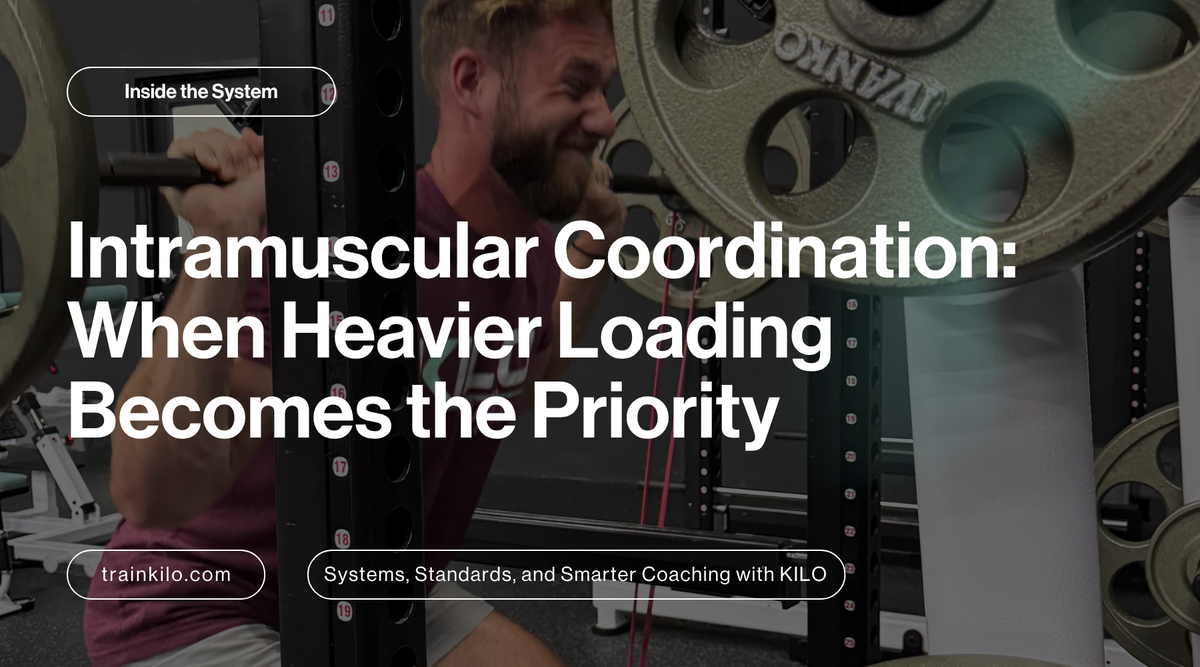
Movement efficiency is an important part of long-term strength development, but efficiency alone cannot maximize force expression. At some point, the trainee needs exposure to heavier loading that challenges the nervous system to recruit high-threshold motor units, increase firing rate, and coordinate force production under demanding conditions. Intermuscular coordination helps build strength potential. Intramuscular coordination helps the trainee access and express more of it.
Intermuscular coordination is one of the most overlooked facets of long-term strength development, but it is not the full picture.
A trainee first needs to become efficient at the lift.
A trainee needs to learn how to brace, maintain position, distribute force, control the eccentric, transition effectively, and produce force through the correct pattern.
This is what allows the movement to become cleaner, more repeatable, and less wasteful.
However, movement efficiency alone is not enough to maximize strength.
At some point, the trainee also needs to improve their ability to access and express high levels of force within the muscles responsible for the lift. This is where intramuscular coordination becomes essential.
Intermuscular coordination builds potential for strength development.
Intramuscular coordination allows the trainee to capitalize on that potential.
Think about it like building a 15-foot-tall bookcase but only having access to a 3-foot stepladder.
The bookcase may have plenty of storage capacity, but most of it is unusable because you cannot reach the top shelves.
The potential exists, but access is limited.
The same idea applies to strength development.
A trainee may improve movement efficiency, build muscle mass, and develop the structural potential to lift heavier loads. But if they cannot recruit high-threshold motor units, increase firing rate, and coordinate force expression under heavy loading, they cannot fully access that potential.
Emphasizing intramuscular coordination gives the trainee a taller ladder. It allows them to access more of the force-producing capacity they have already built.
What Is Intramuscular Coordination?
Intramuscular coordination refers to how effectively the nervous system controls and activates fibers within a muscle.
Once the movement pattern is efficient enough, the athlete still needs to improve the ability to activate the muscle fibers responsible for producing force.
This is especially important when the goal shifts from building general strength potential to displaying higher levels of strength under heavier loading.
Intramuscular coordination includes three primary components:
-
Motor unit recruitment
-
Firing rate
-
Synchronization
All three are trainable qualities.
Motor Unit Recruitment
Motor unit recruitment refers to the ability to activate more motor units within a muscle.
As loading increases, the nervous system recruits additional motor units to produce more force.
This is a major contributor to force development as loading increases toward approximately 80% of 1RM.
This is a learned skill.
Jurgen Hartmann and Harold Tunnemann state in Fitness and Strength Training for All Sports that elite throwers have been found to recruit 85-90% of their entire motor unit pool, whereas untrained individuals may only recruit about 60%.
That matters because strength is not only determined by how much muscle someone has; it is also influenced by how much of that muscle they can access and coordinate during high-force efforts.
A trainee may have the physical structure to produce more force, but if they cannot recruit enough of the available motor unit pool, their ability to express strength will remain limited.
Firing Rate
Firing rate, often referred to as rate coding, refers to how frequently motor units discharge.
As intensities move above roughly 80% of 1RM and closer to maximal loading, firing rate becomes increasingly important.
Once high levels of recruitment have occurred, increasing firing frequency becomes one of the major ways the nervous system continues to increase force output.
This is especially relevant when training at very high intensities.
A load above 90% of 1RM does not simply require the athlete to recruit more motor units. It also requires those motor units to fire rapidly enough to produce high levels of force in a short period of time.
This is one reason heavier loading needs to be trained directly.
Submaximal work can build skill, volume tolerance, and movement efficiency, but at some point the athlete needs to be exposed to loads heavy enough to require high levels of recruitment and firing rate.
Synchronization
Synchronization refers to the timing of motor unit activation.
Improved synchronization can contribute to more coordinated force expression within the muscle, particularly under high-force demands.
This does not mean every motor unit fires at exactly the same time. Rather, the nervous system becomes better at organizing force production when the demand is high.
When a trainee is exposed to heavier loads, the nervous system has to coordinate force expression more effectively.
The movement pattern must remain organized, but the muscles responsible for producing force must also be able to express that force efficiently.
This is where intramuscular coordination becomes essential for displaying higher levels of strength.
It improves force-producing expression within the muscles responsible for the movement.
Why Higher Intensities Matter
Intramuscular coordination is generally trained more effectively with heavier loads, commonly above 80% of 1RM.
These thresholds should not be treated as hard switches.
Motor unit recruitment, firing rate, and synchronization all contribute across a range of intensities. However, their relative importance changes as loading increases.
As load increases toward approximately 80% of 1RM, motor unit recruitment becomes a major contributor to force production.
As loading moves above 80% and closer to maximal intensities, firing rate becomes increasingly important.
Once loading reaches approximately 90% and above, the demands on firing rate for force expression become even more significant.
This is why high-intensity work cannot be ignored forever.
If the trainee never spends time above 80%, they may improve technical proficiency, work capacity, hypertrophy, and general strength potential, but they may not fully develop the ability to access that potential under heavier loading.
At some point, strength needs to be expressed.
This requires exposure to intensities high enough to challenge the nervous system’s ability to recruit, fire, and coordinate force production under demanding conditions.
Disinhibition of Inhibitory Factors
While not directly the same as intramuscular coordination, the same training parameters that improve intramuscular coordination can also improve disinhibition of inhibitory factors.
These inhibitory mechanisms include the Golgi tendon organs, supraspinal inhibitory signals, and Renshaw cells.
These mechanisms do not all work in the same way, but they share a similar practical outcome: they can reduce the amount of force-producing potential the trainee has access to.
In simple terms, they act like protective brakes. These brakes are useful.
The body should have mechanisms that help regulate force output and protect tissues from excessive stress. However, in many cases, these inhibitory mechanisms may be too sensitive relative to the trainee’s actual force-producing potential.
Heavy loading can help desensitize some of these protective brakes over time.
This allows the trainee to access higher levels of motor unit recruitment and rate coding when high levels of force expression are required.
This is one reason intensities above 90% can be especially valuable in the right context.
They do not only challenge the muscles. They challenge the nervous system’s willingness and ability to permit high force output.
However, this also explains why these methods need to be used carefully.
The higher the intensity, the greater the neural, muscular, and recovery cost.
When Intramuscular Coordination Should Become the Priority
Intramuscular coordination should be prioritized when the goal shifts from building movement efficiency to improving force expression.
This does not mean every trainee needs complex rep schemes or frequent exposure to maximal loading.
It means the coach must understand when the trainee is ready to benefit from higher-intensity work and how aggressively that exposure should be introduced.
If a trainee is still learning the movement, intermuscular coordination should remain the priority.
They need to learn how to perform the lift well before they are repeatedly exposed to loads that demand high levels of force expression.
If a trainee has already built movement efficiency, technical consistency, and enough tissue tolerance to handle heavier loading, intramuscular coordination can become a more appropriate emphasis.
The key question is:
Is the trainee limited primarily by their ability to perform the movement efficiently, or by their ability to express force within a movement they already perform well?
If the movement is still inconsistent, heavier loading will often expose and amplify the problem.
If the movement is efficient, heavier loading can be used to develop the ability to access more force-producing capacity.
This is the difference between earning intensity and simply adding load.
Introducing Intramuscular Coordination Progressively
Intramuscular coordination needs to be introduced progressively.
The goal is not to take someone who has never trained above 85% and immediately expose them to multiple sets near repetition-maximum loading.
That may technically train the quality, but it will likely create more fatigue than adaptation.
The first exposure to higher intensities should usually be conservative.
For beginners, or for trainees who have not spent much time above 85%, Step Loading is usually the better entry point.
Step Loading allows the trainee to gradually build toward heavier loads within the session.
The early sets provide technical rehearsal and confidence. The later sets expose the trainee to higher intensities without requiring repeated near-maximal efforts.
This matters because the stress dose is very different.
Step Loading may expose the trainee to one or two truly demanding sets near the top of the intensity range.
Complex rep schemes often expose the trainee to four or more sets close to repetition-maximum loading.
Those are not the same training stress.
For a trainee’s first exposure to intensities at 85% and above, Step Loading usually provides enough stimulus without creating an unnecessary level of fatigue.
The athlete learns to handle heavier loads, but they are not buried by them.
Complex Rep Schemes for Intramuscular Coordination
Once a trainee has enough experience with heavier loading, complex rep schemes can become extremely valuable.
Complex rep schemes refer to methods where very specific rep sequences are prescribed to create a particular loading effect.
They are not just random rep ranges.
They are organized structures designed to manipulate intensity, fatigue, and performance across the session.
For intramuscular coordination, complex rep schemes are useful because they create repeated exposure to high-intensity loading.
Many of these schemes bias a large portion of the work above 80% of 1RM, with all exposures close to or at repetition-maximum loads.
This creates a strong stimulus for motor unit recruitment, firing rate, synchronization, and related disinhibition of inhibitory factors.
However, this also makes them costly because these schemes are performed at high intensities and often close to failure, they can generate large amounts of fatigue.
This means the coach needs to be selective with timing and the trainee’s readiness.
Complex rep schemes are powerful tools, but they are not introductory tools.
They should be used when the athlete is advanced enough to benefit from the increased stress.
For this article, I am going to focus on two complex rep schemes that fit this objective particularly well:
-
Descending reps
-
Stage system descending
Both methods share the same basic purpose.
They allow the trainee to accumulate multiple high-effort exposures while intensity increases across the sequence.
As the repetitions decrease, the load increases, allowing the athlete to move toward heavier intensities without starting the session at the heaviest load.
This makes them useful for intramuscular coordination because the trainee is repeatedly exposed to loads that require high levels of motor unit recruitment, firing rate, and force expression.
However, because each set is performed close to the athlete’s current capacity, these methods also carry a much higher fatigue cost than basic step loading.
Descending Reps
Descending reps are a complex rep scheme where each set increases in intensity by approximately 2-3% while the number of repetitions decreases.
The goal is to load each set close to, or at, the repetition maximum for the prescribed number of reps.
An example would be:
8, 7, 6, 5, 4
Set 1 is completed for 8 reps.
Set 2 is completed for 7 reps.
Set 3 is completed for 6 reps.
This continues until the final set of 4 reps.
As the reps decrease, the load increases.
This structure works well for intramuscular coordination because the trainee accumulates multiple exposures near repetition-maximum loading while gradually increasing intensity across the sequence.
The earlier sets create a strong stimulus but also potentiate the nervous system for the heavier sets that follow.
The gradual reduction in reps allows for a gradual increase in load throughout the sequence, but the overall demand remains high because each set is loaded close to the athlete’s current capacity.
This is very different from simply performing submaximal sets of 8, 7, 6, 5, and 4.
The effectiveness of descending reps comes from the fact that each set is intended to be a high-effort exposure relative to the rep target.
Stage System Descending
Stage system descending is similar to descending reps, but each repetition target is performed twice before moving to the next stage.
The intensity jumps between stages are usually slightly larger, often around 5%.
An example would be:
7, 7, 5, 5, 3, 3
The trainee completes two sets of 7, then two sets of 5, then two sets of 3.
Each stage is loaded close to, or at, the repetition maximum for that rep target.
This method creates a double exposure to each specific rep range and intensity zone.
That double exposure is valuable because it gives the trainee repeated practice expressing force at each stage before moving heavier.
The larger jumps in intensity make this loading structure more advanced because the trainee needs to tolerate bigger increases in load between stages.
Stage system descending can be an effective way to emphasize intramuscular coordination because it combines repeated high-effort exposures with progressive increases in intensity.
The trainee is not just touching a heavy load once.
They are repeatedly asked to recruit, fire, and coordinate force output under demanding conditions.
This can be extremely productive for intermediate and advanced trainees.
It can also be extremely fatiguing.
That is why it needs to be placed carefully within the macrocycle.
Timing Higher-Intensity Methods Within Training
The timing of intramuscular coordination work matters.
Because these methods involve higher intensities and greater proximity to failure, they should not be used randomly throughout the year.
They are most useful when the goal is to intensify training, peak strength expression, or develop the trainee’s ability to handle and express force under heavier loading.
For beginners, Step Loading is usually sufficient.
They may benefit from gradually being exposed to heavier intensities, but they do not need multiple sets close to repetition-maximum loading.
Their main limitation is usually still movement efficiency, technical consistency, and basic strength development.
For intermediate trainees, complex rep schemes can be used sparingly during macrocycles where the goal is to peak or emphasize strength expression.
They can benefit from these methods, but the dose needs to be controlled.
The goal is to expose them to higher levels of force expression without overwhelming their recovery capacity.
For advanced trainees, complex rep schemes can be used more often when intramuscular coordination is a primary emphasis.
These trainees usually have the technical skill, training history, and load tolerance required to benefit from repeated high-intensity exposures.
Even then, more is not always better.
The higher the intensity and the closer the sets are to repetition-maximum loading, the more carefully the coach needs to manage total volume, exercise selection, frequency, and recovery.
The goal is not to prove the athlete can survive heavy work.
The goal is to expose them to enough high-intensity work to adapt without exceeding their ability to recover.
Intramuscular coordination work is highly productive when used at the right time.
It also carries a high recovery cost.
The coach needs to make sure the athlete can afford it.
Practical Application
When prioritizing intramuscular coordination, the goal is to improve the trainee’s ability to access and express force.
This usually requires heavier loading, commonly above 80% of 1RM, with some exposure above 90% when rate coding is the specific priority and the trainee is advanced enough to tolerate it.
The exact method depends on the trainee’s training age, technical proficiency, and tolerance for high-intensity work.
For initial exposure, Step Loading is usually the best starting point.
The trainee can gradually work toward heavier intensities while limiting the number of truly demanding sets.
This introduces the nervous system to higher loads without creating excessive fatigue.
For intermediate exposure, complex rep schemes can be used selectively.
These methods allow the trainee to accumulate repeated exposures near repetition-maximum loading, making them useful during intensification or peaking phases.
For advanced emphasis, complex rep schemes can be used more frequently when the goal is to prioritize intramuscular coordination.
These methods can provide a strong stimulus for motor unit recruitment, firing rate, and synchronization, but they must be programmed with respect for their fatigue cost.
The coach should be watching for several key markers.
The athlete should maintain technical consistency under heavier loading.
Bar speed may slow, but movement quality should not be sacrificed.
Positions should remain stable.
Recovery between sessions should remain adequate enough that performance does not collapse across the phase.
If technical execution breaks down, the athlete may not be ready for the method.
If fatigue accumulates faster than performance improves, the dose may be too high.
Potential Only Matters If You Can Access It
Intramuscular coordination is essential for maximizing strength expression.
Intermuscular coordination helps the trainee become more efficient at the lift.
Intramuscular coordination helps the trainee access more of the force-producing capacity within the muscles responsible for that lift.
One builds potential.
The other allows the trainee to capitalize on it.
This is why higher-intensity training has an important place in long-term strength development.
Loads above 80% challenge the nervous system to recruit higher-threshold motor units, increase firing rate, and coordinate force expression under demanding conditions.
Loads above 90% can be especially useful when increased firing rate is the specific priority.
The key is not simply to train heavy.
The key is to introduce and emphasize heavy training at the right time, with the right method, for the right trainee.
Step Loading can introduce higher intensities. Complex rep schemes can repeat higher intensities.
Both have value, but they do not carry the same stress cost.
For the trainee who has built movement efficiency and now needs to express more force, intramuscular coordination becomes a priority.
Building strength potential is only half the process. The trainee also needs to express it.



Share:
The Route Determines the Result: Sequential Periodization